
Category: Business
Concept of Using a Website Traffic Generator to Drive Website Traffic
The internet in 2026 is louder, faster, and more competitive.the underlying concept behind a website traffic generator https://targetedwebtraffic.com/website-traffic-generator Great content alone doesn’t guarantee attention anymore—distribution does. If people don’t discover your pages, your brand stays invisible, your offers sit untouched, and your SEO progress moves at a crawl.
What a Traffic Generator Really Does (When It’s Done Right)
A traffic generator is any strategy or system designed to increase visits to your website. In 2026, the best ones are not random-hit machines—they are targeted visibility engines. Their job is to:
- Put your pages in front of the right audience
- Send steady visits so your content doesn’t “die” after launch week
- Support campaigns (product launches, new blog posts, local services, promotions)
- Provide data that improves your marketing decisions
Think of it like this: SEO is the long game, but a traffic generator helps you stay in the game while your rankings develop.
The 2026 Metrics That Matter More Than “Traffic”
If you only measure sessions, you’ll miss the truth. In 2026, smart marketers watch behavior first:
- Engaged sessions: Are visitors doing anything meaningful?
- Pages per visit: Do they explore or bounce?
- Top landing pages: Which entry points perform best?
- Returning visitors: Is your website memorable or forgettable?
- Conversion actions: Clicks, sign-ups, calls, purchases
Tools like GA4, Ahrefs, and Moz help you connect traffic to performance. More importantly, they help you separate “busy traffic” from useful traffic.
A simple example: a local service business might get fewer visitors than a national blog—but if those visitors request quotes, call, or book appointments, that’s real success.
Why Traffic and SEO Work Better Together
Search engines don’t rank websites because they exist. They rank websites that prove value over time.
When you combine strong content with a steady flow of relevant visitors, you create a feedback loop:
- Visitors arrive on useful pages
- You see what they click, read, and ignore
- You improve content, structure, and internal links
- Engagement grows
- Pages perform better and earn more visibility
A website traffic generator supports that cycle by giving your site the one thing most websites lack: momentum.
In 2026, momentum is everything. Brands that show up consistently win.
A Modern Example: Launching Without Being Ignored
Imagine a creator launching a new niche blog in 2026—fitness for busy parents, for example.
They publish 10 strong posts, optimize them for search, and set up internal links. But without traffic, those posts sit quietly for months.
Now add a traffic generator into the mix: targeted visits begin landing on the best articles. The creator learns which headlines perform, which topics hold attention, and which pages send readers to the email list. Within weeks, the blog starts building a real audience instead of waiting for luck.
The difference isn’t “more clicks.” The difference is more learning, more visibility, and more opportunity.
Don’t Rely on One Method: Build a Promotion Stack
In 2026, relying on one channel is risky. Algorithms change. Platforms rise and fall. The strongest websites use a promotion stack, such as:
- SEO + content updates
- Social media distribution
- Email newsletters and lead magnets
- Guest posting and collaborations
- Paid campaigns (search + retargeting)
- Community marketing (forums, groups, creators)
Traffic generators fit best inside this stack—supporting your campaigns instead of replacing your strategy.
Final Take: 2026 Is a Visibility Game
A website traffic generator in 2026 isn’t about vanity metrics. It’s about staying visible long enough to build authority, audience, and conversions.
Whether you’re promoting products, services, content, or a cause, the winning advantage is simple: consistent discovery.
Why Is My Website Not Getting Traffic From Google? (And How to Fix It)
If your website isn’t getting traffic from Google, you’re definitely not alone. Millions of website owners deal with the same frustrating issue: pages that don’t rank, keywords that don’t move, and analytics dashboards that look painfully flat. The good news is that Google traffic can be restored or increased—but it requires understanding why the drop or stagnation is happening in the first place.
Below are the most common reasons your website may not be receiving traffic from Google, along with actionable solutions to get things moving again.
1. Your Website Isn’t Properly Indexed by Google
If your pages are not appearing in Google at all, there’s a good chance Google hasn’t indexed your website—or has stopped indexing some pages.
How to check
Search:
site:yourwebsite.com
If only a few pages appear (or none at all), you have an indexing issue.
Fix
- Submit your sitemap in Google Search Console.
- Ensure your pages are not accidentally set to noindex.
- Improve internal linking so Google’s crawler can find your pages easily.
2. You’re Targeting the Wrong Keywords
You might be producing great content, but if your keywords are too competitive or not aligned with what your audience searches, Google simply won’t know where to rank your pages.
Many websites make the mistake of:
- Targeting keywords with massive competition
- Using keywords that don’t match search intent
- Overlooking long-tail keyword opportunities
Fix
Use tools like Google Keyword Planner, Ahrefs, or Semrush and aim for:
- Low-competition
- High-intent
- Long-tail
- Relevant keywords
These are usually easier to rank and bring more qualified traffic.
3. Your Website Has Technical SEO Problems
Google traffic often drops due to technical issues that owners don’t notice. A slow or poorly structured site is a ranking killer.
Common technical SEO issues include:
- Slow loading speed
- Broken links
- Mobile-unfriendly layout
- Poor site structure
- Missing meta tags
- Duplicate content
Fix
Run a technical audit using:
- Google Search Console
- PageSpeed Insights
- Screaming Frog
Fixing even a few of these issues can significantly improve visibility and traffic.
4. Your Content Isn’t Better Than the Competition
Google rewards value. If your competitors offer more detailed, updated, or helpful content, Google will rank them above you.
Ask yourself:
- Does my content fully answer the user’s question?
- Is it more helpful than the top 5 search results?
- Is it formatted well, with headings, visuals, and clear structure?
Google wants to serve users the best answer, not just any answer.
Fix
- Add depth, clarity, and expertise to your content.
- Update older posts regularly.
- Include real examples, data, and actionable tips.
High-quality content still wins, even in 2025.
5. You’re Not Building Authority or Earning Backlinks
Backlinks remain one of the strongest ranking factors. If no one links to your site, Google may assume your content isn’t valuable.
Fix
- Write guest posts
- Create shareable guides
- Build partnerships
- Use digital PR
- Participate in interviews and expert roundups
Remember: even a few strong backlinks often outperform hundreds of weak ones.
6. Your Industry Is Very Competitive
Some niches—like finance, health, marketing, and tech—are extremely difficult to rank in due to high competition.
If you’re in one of these industries, even great content may struggle to break through without:
- Strong backlinks
- Good user metrics
- Solid domain authority
- Consistent content publishing
Don’t get discouraged—Google rewards consistent effort over time.
7. You’re Not Getting Enough Engagement Signals
Google uses engagement metrics (time on page, bounce rate, interaction) as ranking signals. If real visitors engage with your site, Google is more likely to move your rankings upward.
This brings us to an important point…
Can Organic Traffic Boost Rankings?
Yes—real organic human traffic can help improve rankings because it strengthens user-engagement signals such as:
- Time on site
- Bounce rate
- Click-through behavior
- Interaction
- Returning visitors
When Google sees that users engage with your site in a natural way, your rankings can improve gradually.
However, it’s important to note:
Traffic alone cannot guarantee results—but it can support your SEO strategy.
That’s why some businesses choose to supplement their SEO efforts with high-quality organic traffic from reputable sources, especially when:
- They want faster activity on new pages
- They need engagement signals
- They want visitors to interact with certain keywords
Buying low-quality or bot traffic is risky—but buying real organic traffic from trusted, long-standing providers can support SEO efforts naturally without harming your site.
Just make sure the traffic is:
- Real
- From reputable websites
- Keyword-targeted
- Traceable
- From clean and verified sources
This gives your content the push it needs while you continue improving SEO organically.
8. SEO Takes Time—Patience Matters
One of the biggest reasons websites don’t get Google traffic is simple: SEO takes time.
Even with perfect content and optimization, ranking improvements can take:
- 3–6 months for moderate keywords
- 6–12 months for competitive ones
This slow pace discourages many business owners, but persistence usually pays off.
Final Thoughts
If your website isn’t getting traffic from Google, it’s usually due to a mix of indexing issues, keyword targeting, technical problems, weak content, or lack of authority. The good news is that these issues are fixable—and with consistent work, your rankings can improve.
To accelerate the process, many businesses also use trusted organic traffic sources to help increase engagement signals and support ongoing SEO efforts. Just make sure any traffic you use is high-quality, real,
Get Results with Our Special SEO Service and Rank on the First Page! | LinkedIn
How to Increase Website Traffic: 11 Proven Strategies for Success
Contact US – Get in Touch with Targeted Visitors
Digital Marketing Consultant: How Can I Get 1000 Daily Visitors? | LinkedIn
Complete Tutorial for builders in Java (in simple language)

In this tutorial, you will get acquainted with builders in Java; How to create and use builders with the help of examples.
What is a manufacturer?
The constructor is similar to the method (but not the method) that is called automatically when the object is created.
The Java compiler distinguishes between method and constructor using the name and type of recursive. In Java, the constructor has a class-like name and does not return any values.
class Test {
Test() {
// constructor body
}
}
Here, Test () is constructive. It has the same class name and no return type.
class Test {
void Test() {
// method body
}
}
Here, Test () has the same name as the class. However, its return type is void. Hence, it is not constructive but methodical.
Example: Builder in Java
- class ConsMain {
- private int x;
- // constructor
- private ConsMain(){
- System.out.println(“Constructor Called”);
- x = 5;
- }
- public static void main(String[] args){
- ConsMain obj = new ConsMain();
- System.out.println(“Value of x = ” + obj.x);
- }
- }
Output
Constructor Called
Value of x = 5
Here, the ConsMain () constructor is called when the obj object is created.
A constructor may or may not accept an argument.
Builder without arguments
If the Java constructor does not accept any parameters, the constructor is no-arg. Its structure is as follows:
accessModifier ClassName() {
// constructor body
}
Sample constructor without arguments
- class NoArgCtor {
- int i;
- // constructor with no parameter
- private NoArgCtor(){
- i = 5;
- System.out.println(“Object created and i = ” + i);
- }
- public static void main(String[] args) {
- NoArgCtor obj = new NoArgCtor();
- }
- }
Output
Object created and i = 5
Here, the NoArgCtor () constructor does not accept any parameters.
Did you notice that the creator of NoArgCtor () is private?
This is because the object is made from within the same class. Hence, it can access the manufacturer.
However, if the object is created outside of class, you must make access to that constructor public. For example:
- class Company {
- String domainName;
- // object is created in another class
- public Company(){
- domainName = “programiz.com”;
- }
- }
- public class CompanyImplementation {
- public static void main(String[] args) {
- Company companyObj = new Company();
- System.out.println(“Domain name = “+ companyObj.domainName);
- }
- }
Output
Domain name = targetedwebtraffic.com
Default builder
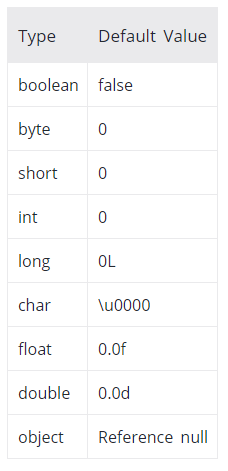
If you do not create the builder yourself, the Java compiler will automatically create a builder without arguments at runtime. This builder is known as the default builder. The default constructor initializes each of the informal sample variables.
Example: Default builder
- class DefaultConstructor {
- int a;
- boolean b;
- public static void main(String[] args) {
- DefaultConstructor obj = new DefaultConstructor();
- System.out.println(“a = ” + obj.a);
- System.out.println(“b = ” + obj.b);
- }
- }
The above program is equivalent to:
- class DefaultConstructor {
- int a;
- boolean b;
- private DefaultConstructor() {
- a = 0;
- b = false;
- }
- public static void main(String[] args) {
- DefaultConstructor obj = new DefaultConstructor();
- System.out.println(“a = ” + obj.a);
- System.out.println(“b = ” + obj.b);
- }
- }
Output
a = 0
b = false
Parametric constructor
A constructor may also accept parameters. Its structure is as follows:
accessModifier ClassName(arg1, arg2, …, argn) {
// constructor body
}
Example: Parametric constructor
- class Vehicle {
- int wheels;
- private Vehicle(int wheels){
- wheels = wheels;
- System.out.println(wheels + ” wheeler vehicle created.”);
- }
- public static void main(String[] args) {
- Vehicle v1 = new Vehicle(2);
- Vehicle v2 = new Vehicle(3);
- Vehicle v3 = new Vehicle(4);
- }
- }
Output
wheeler vehicle created.
wheeler vehicle created.
wheeler vehicle created.
Here, we passed an int (number of wheels) argument to the constructor when creating the object.
Overload builders in Java
Similar to method overloading, you can have two or more manufacturers with the same name with different parameters. For example:
- class Company {
- String domainName;
- public Company(){
- this.domainName = “default”;
- }
- public Company(String domainName){
- this.domainName = domainName;
- }
- public void getName(){
- System.out.println(this.domainName);
- }
- public static void main(String[] args) {
- Company defaultObj = new Company();
- Company programizObj = new Company(“programiz.com”);
- defaultObj.getName();
- programizObj.getName();
- }
- }
Output
important points
- Immediately after calling the objects, the creators are called.
- The two laws of creation are:
- The Java constructor name must exactly match the class name.
- A Java builder should not have a recursive type.
- If it does not have a constructor class, the Java compiler automatically generates a default constructor at runtime. The default constructor initializes the sample variables with the default values. For example: the variable int is equal to 0.
- Manufacturer types:
- No-Arg Constructor – A constructor that accepts no arguments
- Default Builder – A builder created automatically by a Java compiler. (If not explicitly defined)
- Parameter constructor – Used to specify specific values of variables in an object
- Creators can not be abstract or static or final.
- The constructor can be defined several times.
Sources:
Popular Teaching Methods And Tools 2022

The spread of the corona virus in the world has caused many changes. The field of education was the first to be most influential; Schools, universities, and educational institutions were closed, and students, teachers, students, and faculty were forced to look for new ways to continue the education process. In this situation, technology came to our aid. Social networks , virtual classrooms and instructional videos have enabled many to continue their education. These technologies existed before the Corona epidemic, but their use was less common. These technologies have now become an important part of the teaching and learning process and will continue to influence this field in the future. In this article, we look at the future of technology in education. Stay with us until the end. Show study guide
What is the future of technology in education?
The application of technology in education is not limited to the period of the Corona epidemic. These technologies are rapidly changing teaching methods. The new generation is more inclined to receive education through these technologies. Of course, this does not mean eliminating traditional classrooms, and these technologies will complement classrooms.
In a survey of education activists, 75 percent predicted that digital devices such as tablets and e-books would replace paper textbooks in classrooms. Studies have also shown that virtual reality is one of the most attractive technologies that will soon open a place for itself in education. These examples show that the way of teaching will change completely. With the emergence and entry of various technologies in this field, the main challenge for teachers is to select and combine the most appropriate tools to advance the teaching process.
What are the necessary developments to educate the new generation?
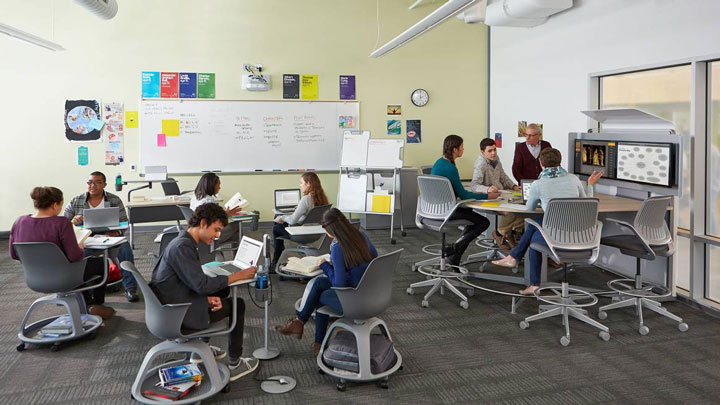
Let’s take a look at the educational needs of the new generation and the changes that have taken place in the way learners learn. Education activists must read these items.
1. One-click access to educational content
The Internet has made it possible for billions of people to access data and educational content in a fraction of a second. As of 2017, more than 6.5 million people have been involved in e-learning.
Distance learning has its own challenges, but it also gives teachers the flexibility to be able to tailor their curriculum. Learners no longer need to attend classes. They can watch live or recorded class videos remotely. Teachers and educators must adapt to the new way of teaching.
2. Loss of temporal and spatial boundaries
One of the most important features of future education is the elimination of temporal and spatial constraints. Today, almost anyone with access to the Internet can access thousands of virtual training courses from anywhere in the world at any time. This means that training is no longer a formal process limited to a specific time and place, and everyone can follow the training they want at any time and place.
3. Specialization of education and variety of learning methods
In the past, the same group training was offered without considering the abilities of each individual, but technological developments have made teaching and learning a specific and individual issue. Today, everyone can receive a special training program depending on their abilities. This means that more training programs will be designed based on each person’s unique talents and abilities. Each learner can use one of the educational programs and tools depending on their abilities and interests.
4. Soft skills training
Various studies show that the job market today pays more attention to soft skills such as teamwork, creativity and critical thinking . Job seekers who learn these skills are more likely to be successful than those who have learned only difficult skills. This means that the education sector will pay more attention to teaching these skills in the near future.
5. A solution to the problem of reducing attention span
One of the problems faced by education activists is the issue of reducing the attention span of the new generation. A study by Microsoft shows that the learner attention span decreased by 4 seconds from 2000 to 2015, from 12 seconds to 8 seconds. This period will probably become shorter with the increasing influence of technology in human life.
The new generation pays more attention to visual and exciting content. Therefore, educational institutions and activists in this field must find attractive and new ways to attract the attention of the new generation to educational content.
6. Facilitation instead of education
Now that a whole new generation of educational content has been provided, learners feel more independent in learning and no longer depend on the teacher to learn as they used to. The role of teachers has now become a source of knowledge and a facilitator of learning.
Teachers now need to learn and apply soft skills such as problem solving and leadership to play a new role . Education activists must now turn the learning environment into a space for teamwork and dialogue.
Future teaching tools and methods

Now that you are familiar with some of the technological developments in educating the new generation, it is time to move on to the educational tools that will be used in the field of broad education in the near future. The purpose of using these tools is to meet the educational needs of the new generation and to train the skills that this generation needs to enter the labor market.
1. virtual teaching
Virtual education was also available in previous years, but was often very limited. Now, with the development of communication tools and the requirements that the corona epidemic has imposed on the education sector, this method has become widespread and popular all over the world. Virtual education is no longer just watching some boring videos from the classroom, but has become an active and effective way of teaching with the help of interactive tools.
Schools, universities and educational institutions now offer many of their courses and courses in a virtual way.
2. Artificial intelligence-based training programs
Businesses and the health sector are two areas in which artificial intelligence is growing rapidly. But the education sector is not far behind. The use of automated scoring systems and intelligent educational assistants are examples of the introduction of artificial intelligence into the education sector.
One interesting example is the question robot built by David Kellerman. First used at the University of New South Wales, the robot answers students’ questions by sending related files or instructional videos. This robot overcomes its weaknesses with each interaction and is a learning machine.
This example shows that artificial intelligence can have a future in education. AI responds to tedious tasks and repetitive questions to make teachers focus on more complex issues.
3. Immersion in the learning environment with the help of augmented reality and virtual reality technology
One of the attractive and effective tools that can solve the new generation attention span problem is augmented reality and virtual reality. These two tools immerse the learner in the learning environment, diverting all his attention and senses to the learning experience. These tools are especially useful for those learners who suffer from attention deficit disorder and make learning enjoyable.
In addition, these two technologies allow learners to learn things more deeply and from new angles, and deepen their learning.
4. Gamification
Transforming the work environment and work process into something like a game or gamification has been the focus of business activists for several years. Now the education department is gradually using the capacities of this method to teach the course content. Turning the process of teaching a content into a game makes the content attractive and learners pay more attention to it.
5. Use of data analysis in training
Data is very valuable in today’s world, and the education sector, although later than others, has finally realized this. Data analysis allows teachers to have a better view of the situation of learners and use the results of data analysis to optimally change teaching methods.
The use of data analysis in education is also encouraging for learners, because they understand that their voice is heard and effective.
6. Blockchain training and technology
Blockchain technology offers unique benefits in education. Storing data and large virtual courses through this technology, instead of being stored on a central server, can reduce the cost of virtual education and increase the security of learners in cyberspace.
7. Talking Robots
If you are looking for tips to write an article or you want to edit your textbooks, talking bots will help you. Robots that have the ability to talk to and guide learners will soon become an integral part of educational websites.
8. Instructional videos
Making instructional videos using various animation and graphic software has become very popular in recent years. As mentioned, the new generation is more interested in visual content. Realizing this, education activists also design and produce a variety of educational clips to better convey educational content to learners.
In today’s world, more than 2.3 billion people in the world are studying to watch educational movies, and this number will increase in the future.
What is your opinion about these developments? Have you experienced using any of the examples introduced in this article? It can be interesting to read about your experience.
 Going Beyond Business